Blog
21
Jul
Best Historical Places In Dhaka
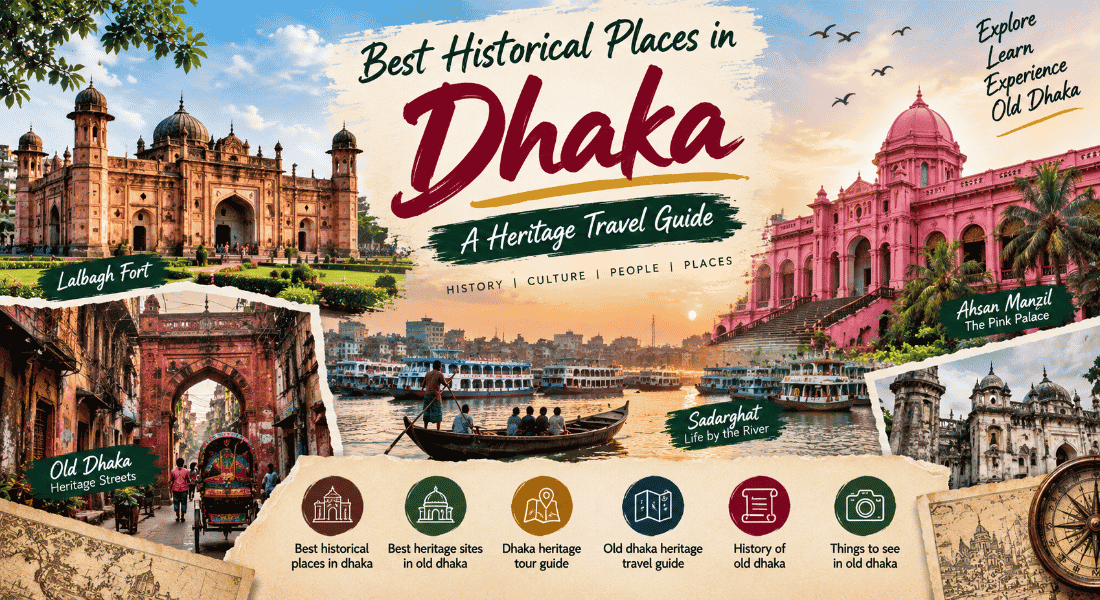
Best Historical Places in Dhaka: A Heritage Travel Guide
Dhaka is a city of layers. Beneath the chaos of modern life – the traffic, the crowds, the constant construction – lies a history that spans over four centuries. The city has been a Mughal provincial capital, a British colonial outpost, and the heart of a young nation's independence movement.
For travelers who want to look beyond the surface, Dhaka's historical places offer a journey through time. But where do you start? This guide covers the best historical places in Dhaka, what makes each one significant, and how to plan your heritage exploration.
Dhaka's Historical Timeline
Before diving into specific sites, it helps to understand Dhaka's historical periods:
Mughal Period (1608–1757): Dhaka became the capital of Bengal under Mughal rule. This was the city's golden age of architecture, with mosques, palaces, and gardens built along the Buriganga River.
British Colonial Period (1757–1947): The British East India Company took control, and later the British Crown. Dhaka declined in importance but saw the construction of colonial buildings, churches, and administrative structures.
Pakistan Period (1947–1971): Dhaka became the capital of East Pakistan. This period saw political turmoil and the growth of the independence movement.
Independent Bangladesh (1971–present): The city expanded rapidly as the capital of the new nation. Modern structures now dominate the skyline, but the historical sites remain.
For more on the city's heritage, check our guide on Dhaka heritage tour guide.
Mughal-Era Historical Places
Lalbagh Fort
Lalbagh Fort is Dhaka's most famous Mughal structure. Construction began in 1678 under Prince Muhammad Azam, the son of Emperor Aurangzeb. The fort was never completed, but what remains is impressive.
What to see:
The three-domed mosque, still in use today
The Diwan-i-Aam (Hall of Public Audience)
The tomb of Pari Bibi, daughter of a governor, with its beautiful marble
The remains of the fort walls and gates
Significance: Lalbagh Fort represents the ambition of Mughal architecture in Bengal. Even in its unfinished state, it's Dhaka's most important Mughal monument.
Location: Old Dhaka, near the Buriganga River
Best time to visit: Morning (9–11 AM) for cooler weather and better light for photographs
Ahsan Manzil
Known as the Pink Palace, Ahsan Manzil was the official residence of the Dhaka Nawab family. Built in 1872, it's a stunning example of Indo-Saracenic architecture – a blend of Mughal, European, and Hindu styles.
What to see:
The grand Durbar Hall with its European chandeliers
The Nawab's private quarters
The beautifully restored interior
The museum displaying artifacts from the British period
The gardens overlooking the Buriganga River
Significance: Ahsan Manzil is a symbol of Dhaka's wealthy landed aristocracy during the British period. It's also where many important political discussions took place.
Location: Kumartoli, Old Dhaka, on the banks of the Buriganga
Opening hours: 10 AM–5 PM (closed Thursday)
Entry fee: Approximately 300 BDT (foreigners)
Bara Katra and Choto Katra
These are two historic caravanserais (rest stops for traders) built during the Mughal period. Bara Katra was built around 1644, and Choto Katra in 1664. They were used by merchants traveling along the trade routes of Bengal.
What to see:
The impressive gateways of both structures
The courtyard of Bara Katra
The arches and columns that show Mughal architectural influence
The bustling neighborhood that has grown around them
Significance: These structures show Dhaka's importance as a commercial center during the Mughal period. They're also examples of the caravanserai architecture that was common across South Asia.
Location: Chawkbazar area, Old Dhaka
Note: These structures are largely in disrepair but are still worth visiting for the history and atmosphere.
Sat Gambuj Mosque
Located in the fortified area of Dhaka, the Sat Gambuj Mosque (Seven Domed Mosque) is one of the city's oldest Mughal mosques. It was built in the 17th century.
What to see:
The seven domes that give the mosque its name
The Mughal-era design
The peaceful atmosphere, a contrast to the chaos outside
Significance: It's one of the few remaining Mughal mosques in Dhaka and a rare example of the seven-domed style.
Location: Within the old fort area of Dhaka
British Colonial Historical Places
Curzon Hall
Curzon Hall is one of Dhaka's most beautiful British-era buildings. It was built in 1904 as a town hall and named after Lord Curzon, the then Viceroy of India. Today, it's part of the University of Dhaka.
What to see:
The striking red-brick architecture with European and Mughal influences
The grand central hall with its arched ceiling
The symmetrical wings
The gardens and campus setting
Significance: Curzon Hall is a symbol of British-era education in Bengal. It's also where many of the 1971 independence movement discussions took place.
Location: University of Dhaka campus
Best time to visit: Morning or late afternoon for the best light
Dhaka University Area
The University of Dhaka area contains several historical buildings beyond Curzon Hall:
The Old Faculty of Arts Building – Another beautiful colonial structure
The Senate Building – The university's main administrative building
The Central Library – A historic institution
Significance: Dhaka University was the center of Bangladesh's independence movement. The area is filled with historical and emotional significance.
Ramna Park
Though not a building, Ramna Park is a historic public space. It was developed during the British period as a recreational area.
What to see:
The large green spaces and old trees
The lake at the center
The British-era design
Significance: Ramna Park is one of Dhaka's oldest public parks. It has been a gathering place for generations.
Location: Central Dhaka, near the Sheraton Hotel
Old Dhaka Heritage Sites
Old Dhaka is the historic heart of the city. The narrow lanes, old buildings, and vibrant street life create a unique atmosphere.
Armenian Church
The Armenian Church is one of Dhaka's oldest churches, built in 1781. It was constructed by the Armenian community that once had a significant presence in Dhaka.
What to see:
The distinctive architecture, including the spire
The historical graveyard
The interior with its old furnishings
The peaceful atmosphere
Significance: The church is a reminder of Dhaka's multicultural past. It's one of the oldest Christian structures in the city.
Location: Armenian Street, Old Dhaka
Best time to visit: Morning, when the church is most peaceful
Ruplal House
Ruplal House is a stunning example of colonial-era architecture on the banks of the Buriganga. Built in the 19th century, it reflects the wealth of the city's merchant class.
What to see:
The grand facade facing the river
The architectural details
The view over the Buriganga
Significance: Ruplal House shows the affluence of Dhaka's trading community during the British period.
Location: On the banks of the Buriganga River, Old Dhaka
Note: The building is partially in disrepair but still impressive.
Dhakeshwari Temple
Dhakeshwari Temple is the national temple of Bangladesh. While the current structure dates from the British period, the site has been used for Hindu worship for centuries.
What to see:
The main temple complex
The goddess Durga as the presiding deity
The surrounding temple structures
The courtyard and gardens
Significance: This is the most important Hindu temple in Bangladesh. It's also where the country's most significant Durga Puja celebrations take place.
Location: Central Dhaka, near the University
Sadarghat
The riverfront at Sadarghat is the heart of Old Dhaka. It's where the Buriganga River comes alive with boats, barges, and ferries.
What to see:
The busy boat traffic on the river
The old buildings along the waterfront
The daily life of the river community
The sunset over the river
Significance: Sadarghat has been Dhaka's river port for centuries. It's where the city's trade began.
Location: On the banks of the Buriganga River, Old Dhaka
Best time to visit: Morning for the busy activity, evening for the sunset
Other Historical Places Worth Visiting
Sonargaon
Technically outside Dhaka but close enough for a day trip, Sonargaon was the ancient capital of Bengal. It's now an open-air museum with incredible historical structures.
What to see:
Panam Nagar – the abandoned colonial city
The Folk Art Museum
The historic temples and mosques
The decaying colonial buildings
Significance: Sonargaon was Bengal's capital before Dhaka. It's a journey into the country's deeper history.
Distance from Dhaka: 30 kilometers (1 hour)
For more details, check our guide on best heritage sites in Old Dhaka.
Planning Your Historical Heritage Tour
Suggested Itinerary
Option 1: Old Dhaka Day (7–8 hours)
Morning: Lalbagh Fort (2 hours)
Late morning: Ahsan Manzil (2 hours)
Afternoon: Armenian Church, Ruplal House, and walk through Old Dhaka's lanes
Evening: Sadarghat riverfront for sunset
Option 2: Heritage Walk (4–5 hours)
Morning: Dhakeshwari Temple
Walk through the lanes of Old Dhaka
Visit Bara Katra and Choto Katra
End at the Armenian Church
Option 3: Colonial Dhaka (3–4 hours)
Visit Curzon Hall and University of Dhaka buildings
Walk through Ramna Park
Visit the National Museum (if time permits)
Transport Tips
Walking: Old Dhaka is best explored on foot. The lanes are narrow and traffic is chaotic.
Rickshaw: The ideal transport for short distances in Old Dhaka.
Private car: Useful for getting between the different areas but not practical inside Old Dhaka.
CNG: Available throughout the city for short trips.
Best Time to Visit
October to March: The best time for heritage exploration. The weather is cooler and more comfortable for walking.
Morning (7–10 AM): The most pleasant time to visit outdoor sites.
Avoid: Visiting during the heat of the day (11 AM–3 PM) in summer months.
What to Wear
Comfortable walking shoes – you'll be on your feet a lot
Modest clothing for visiting religious sites
Light, breathable fabrics for the heat
A hat and sunscreen for sun protection
Photography Tips
Lalbagh Fort: Best in morning light
Ahsan Manzil: The pink color is most vibrant in the morning
Sadarghat: Sunset offers dramatic river views
Old Dhaka lanes: Candid street photography opportunities
Curzon Hall: Red brick is stunning in late afternoon light
Responsible Heritage Tourism
Dhaka's heritage sites face numerous challenges: neglect, pollution, encroachment, and lack of maintenance. As a visitor, you can help:
Respect the sites: Don't touch or climb on delicate structures
Don't litter: Carry your waste with you
Support local businesses: Eat at local restaurants, buy from local vendors
Spread awareness: Share your experiences and encourage others to visit
Be patient: Many sites are in disrepair – appreciate them for what they are
Conclusion
Dhaka's historical places tell the story of a city that has survived and thrived through centuries of change. From the Mughal grandeur of Lalbagh Fort to the colonial elegance of Ahsan Manzil, from the spiritual significance of Dhakeshwari Temple to the vibrant life of Sadarghat, each site offers a window into a different era.
Don't miss:
Lalbagh Fort – Dhaka's most important Mughal monument
Ahsan Manzil – the iconic Pink Palace
Curzon Hall – a symbol of British-era education
The lanes of Old Dhaka – for the authentic experience
Sadarghat – for the river life
Heritage exploration in Dhaka requires patience and an open mind. The sites may be crowded, the traffic challenging, and the conditions sometimes difficult. But for those who make the effort, the rewards are unforgettable.
FAQ Questions
1. What are the most famous historical places in Dhaka?
The most famous are Lalbagh Fort, Ahsan Manzil (Pink Palace), Dhakeshwari Temple, Curzon Hall, and the Armenian Church. Each represents a different period of Dhaka's history.
2. Is Lalbagh Fort worth visiting?
Yes, it's Dhaka's most important Mughal monument. Even in its unfinished state, the fort is impressive and offers a glimpse into Dhaka's Mughal past.
3. How much time do I need to see Dhaka's historical sites?
A full day is enough to see the major sites in Old Dhaka and the University area. For a deeper exploration, allow 2–3 days.
4. What is the best time to visit Dhaka's historical places?
October to March offers the most comfortable weather. Morning visits (7–10 AM) are best for avoiding the heat and crowds.
5. Is it safe to walk around Old Dhaka?
Yes, but be aware of your surroundings. The lanes are narrow and crowded. Keep your valuables secure and avoid walking alone at night.
6. Can I visit Dhaka's historical sites independently?
Yes, all sites are accessible to independent travelers. However, a guide can provide valuable context and help you navigate Old Dhaka's lanes.
CTA: Want to explore Dhaka's rich heritage with expert guidance? Explore Otithi's heritage tours and cultural experiences for an authentic journey through Bangladesh's history.