Blog
09
Nov
Community-based tourism: A new journey begins
BRAC’s Otithi initiative fosters a beneficial connection between tourists and host communities.
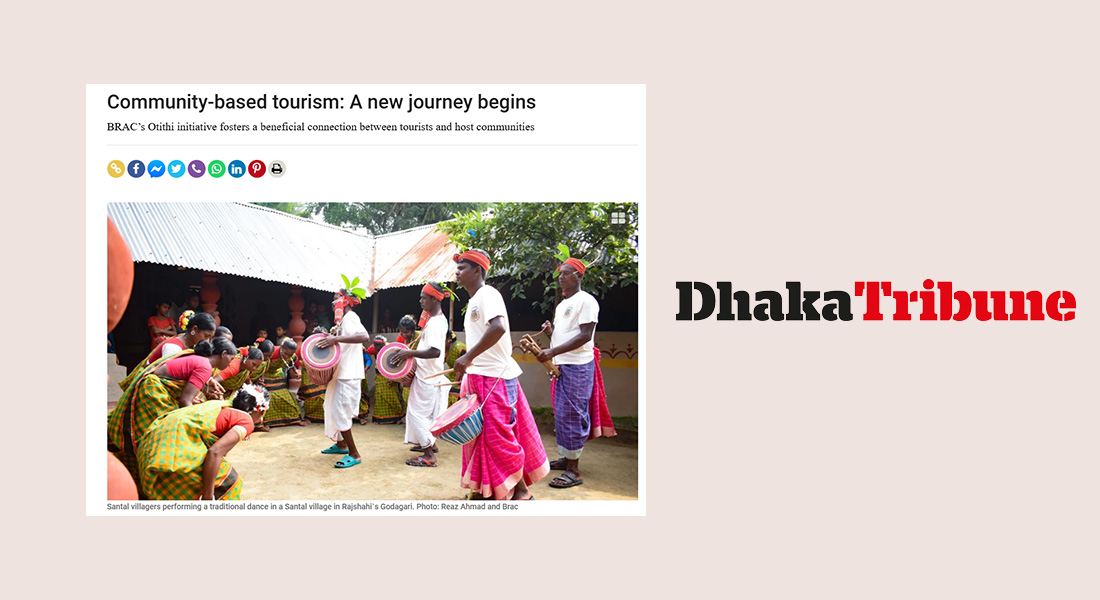
Happy Soren, a young management graduate, comes from a traditional Santal village in Rajshahi. She belongs to a community that represents the largest ethnic minority in the Rajshahi and Rangpur divisions of northern Bangladesh.
Typically a quiet village in Rajshahi’s Godagari, where the Mahananda River meets the mighty Padma, Happy’s neighborhood offers many attractions to visitors from the towns – a rich cultural heritage, traditional cuisine, and mud houses adorned with colorful motifs showcasing the artistic prowess of Santal women.
The village, known as Gordaing, is home to around 250 members of the Santal community, where farming is the mainstay of the rural economy. Nearby, a few Bengali families reside, and several hundred Oraon people live in neighboring villages. Like the Santal, the Oraon also have their distinct language and rich cultural traditions.
For Happy Soren, working as a tour guide and hosting tourist groups visiting her village from the cities is a new but fascinating experience. She notes that her fellow villagers appreciate the tourists visiting Gordaing and spending quality time learning about the rich ethnic and cultural diversity that Bangladesh proudly boasts. Happy values the new tourism initiative that involves local communities.
Thanks to Otithi, a new BRAC-led tourism initiative, rural youth like Happy Soren are becoming involved in promoting community-based, eco-friendly tourism throughout Bangladesh. Otithi’s journey began in Rajshahi with a launch event on November 3.
Like Happy Soren, Binoy Kumar Pal of Dumuria village in Godagari also finds it fulfilling to interact with tourists who appreciate their rural artisan livelihood. Binoy is a master craftsman who creates beautiful pottery using a potter’s wheel, bakes the pieces in the sun and kiln, and displays them in a shop in his front yard. His community consists of at least 20 potter families who sustain the tradition by passing their skills to the next generation. Binoy has recently experienced visits from tourists who show interest in his craftsmanship, appreciating the work the potters do and the value they create.
BRAC’s Otithi initiative fosters a beneficial connection between tourists and host communities. On one hand, it provides tourists with immersive experiences, and on the other, it involves local communities in tour operations in various ways. This approach aims to enhance tourists’ experiences by drawing from the knowledge, culture, and hospitality of the local communities at heritage sites. At the same time, the communities have an opportunity to share their stories and work with their guests.
For both local and foreign tourists, visiting communities like the potters and the Santal is just one part of the experience. An Otithi tour also includes sites of historical significance. For instance, Otithi’s trained tour guides lead tourists through the Varendra Research Museum, the oldest museum in the region (established in East Bengal in 1910). The museum’s collection includes relics from the Indus Valley Civilization (2500 BC), findings from Paharpur excavations (8th-12th century AD), and hundreds of other artifacts. Otithi guides also showcase the architectural splendor of Puthia Rajbari, an Indo-Saracenic revival-style palace built in 1895 and situated on the Rajshahi-Natore highway.
Moutushi Biswas, a model and actress, has played a significant role in realizing BRAC’s Otithi initiative for community-based tourism. She shares her journey as a consultant for the project and describes how the team selected sites, identified the right communities, and trained young tour guides.
BRAC Executive Director Asif Saleh attended the launch event in Rajshahi and elaborated on the idea of placing communities and their rich heritage at the center of tourism—a sector with significant potential in Bangladesh. Through Otithi, BRAC aims to showcase local communities' cultural heritage, historical landmarks, and natural beauty while contributing to the long-term development of the country's growing tourism sector.
Asif Saleh said: “Those of us who work at BRAC travel all over the country and know there is so much in Bangladesh that deserves to be seen and experienced. If curated well, we could truly reimagine our tourism industry in ways that benefit local communities. This vision inspired the creation of Otithi. Starting here in Rajshahi, we aim to spotlight our unique cultural diversity and history across Bangladesh, presenting them anew to local and foreign tourists while ensuring that local communities benefit from tourism.”
BRAC has signed a memorandum of understanding (MoU) with the Bangladesh Tourism Board (BTB), a pioneer in developing community-based tourism in the country. One of the key objectives of the MoU is to promote and develop community-based tourism across different regions of Bangladesh. BTB CEO Abu Tahir Muhammad Jaber, who was also present at the Otithi launch event, spoke about BTB’s experience with community-based tourism in Komolganj Bhanubeel, Moulvibazar district, involving the local Manipuri community.
Last year, over 30 million domestic tourists and 655,000 foreign tourists vacationed in Bangladesh. BTB CEO Abu Tahir Muhammad Jaber noted, “We have developed a master plan for tourism in Bangladesh, set to be fully implemented by 2040. The plan aims to generate 5 billion USD from the sector, with a focus on community-based tourism. We look forward to collaborating with BRAC to further this development.”
The event was also attended by Tamara Hasan Abed, Managing Director of BRAC Enterprises; Dr Md. Jafar Uddin, Senior Adviser at BRAC; Dr Dewan Muhammad Humayun Kabir, Divisional Commissioner (Additional Secretary) of Rajshahi Division; Dr Kazi M. Mostafizur Rahman, Director-in-Charge; and Md. Aslam Reza, Deputy Librarian of the Varendra Research Museum, Rajshahi University. The event featured a musical performance by the local indigenous band Karsa and a traditional Gombhira performance, a type of Bangla song and dance originating in Northwestern Bangladesh.
Source: https://www.dhakatribune.com/bangladesh