Blog
27
Jul
History Of Old Dhaka
History of Old Dhaka: From Mughal Capital to Modern Metropolis
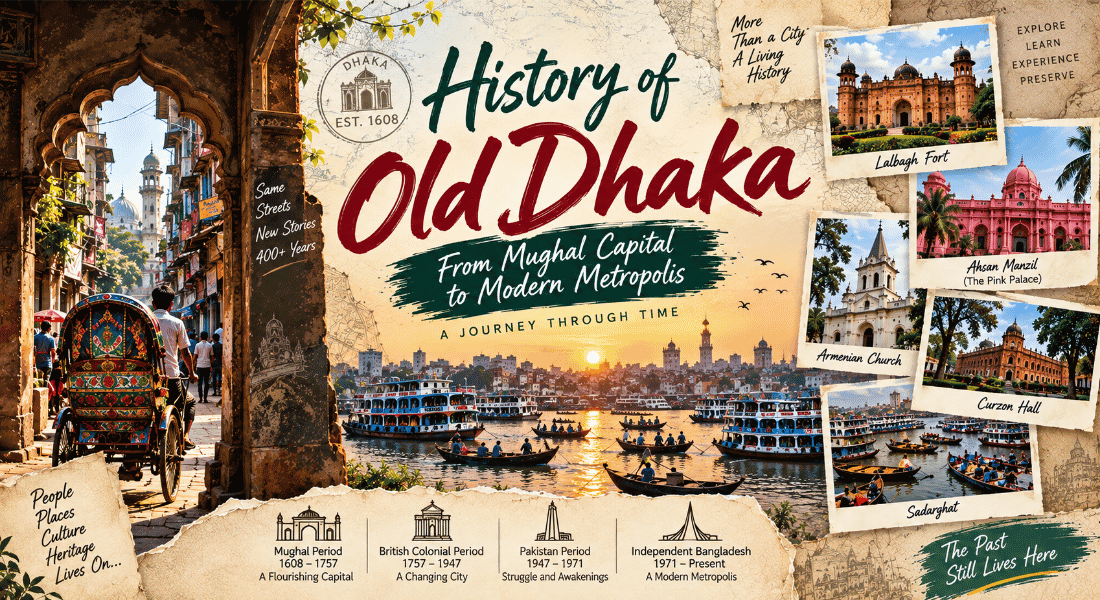
Old Dhaka is not just a part of the city – it's the city's soul. The narrow lanes, the crumbling buildings, the bustling riverfront, and the vibrant street life all tell a story that spans over four centuries. To understand Dhaka today, you need to understand Old Dhaka's history.
This guide takes you through the key periods that shaped Old Dhaka, the people who lived there, and the legacy that remains visible today.
The Origins: A Trading Post on the River
Long before Dhaka became a capital, it was a small trading settlement on the banks of the Buriganga River. The name "Dhaka" is believed to come from the dhak tree, which was common in the region. The river was the lifeblood of the settlement, connecting it to the wider trade networks of Bengal.
But everything changed in 1608. That year, the Mughals made Dhaka the capital of Bengal, and the city's transformation began. Old Dhaka was born.
The Mughal Period (1608–1757)
The Foundation of a Capital
When the Mughals chose Dhaka as Bengal's capital, they needed to build a city worthy of that status. The riverfront along the Buriganga became the center of activity. Here, the Mughals constructed palaces, mosques, gardens, and fortifications.
Key developments during this period:
Lalbagh Fort – Construction began in 1678 under Prince Muhammad Azam
Bara Katra and Choto Katra – Caravanserais built in the 17th century for merchants
Sat Gambuj Mosque – One of the earliest Mughal mosques in the city
The riverfront palaces – Homes of the wealthy and powerful
The Caravanserais
Bara Katra (built 1644) and Choto Katra (built 1664) were more than just rest stops. They were the centers of Dhaka's commercial life. Travelers from across the Mughal Empire and beyond would stay here, trading goods like textiles, spices, and handicrafts.
The merchants who passed through Dhaka helped spread the city's reputation as a center of fine muslin production. Dhaka's muslin was prized across the world – from the courts of the Mughals to the palaces of Europe.
The Textile Industry
Dhaka's fame during the Mughal period rested largely on its textiles. The city was famous for muslin, a fabric so fine that it was almost transparent. The tradition of Dhaka muslin dates back centuries and made the city one of Bengal's most important economic centers.
Life in Mughal Dhaka
What was Old Dhaka like during this period? The streets were narrower but less crowded. The riverfront was lined with the palaces of the wealthy. The markets were filled with textiles, spices, and imported goods. Mosques were at the center of community life, and the city was a vibrant center of culture and commerce.
The Decline Under the Nawabs
In 1717, the Mughals moved their capital from Dhaka to Murshidabad. Dhaka lost its status, and the city's decline began. The wealthy families left, and the grand buildings fell into disrepair.
The British Colonial Period (1757–1947)
The Advent of British Rule
The British East India Company defeated the Nawab of Bengal at the Battle of Plassey in 1757. Bengal, including Dhaka, came under British control. For Dhaka, this was a period of decline. The British focused their attention on Calcutta, which became their capital. Dhaka was neglected.
But the British period also brought new developments:
New administrative buildings – The British built offices and courts
The Armenian Church – Built in 1781 for the Armenian community
The riverfront development – Jetties and docks for trade
The Nawab Period
While Dhaka declined under the British, the city's wealthy families continued to hold influence. The Nawab family of Dhaka was the most prominent. They built grand homes, sponsored cultural activities, and maintained the city's traditions.
Ahsan Manzil was the residence of the Dhaka Nawab family. Built in 1872, it's an iconic symbol of the period. The building combined European, Mughal, and Hindu styles – a reflection of the changing times.
The Armenian Community
The Armenian Church is a reminder of Dhaka's multicultural past. Armenians were part of Dhaka's life from the 17th century. They were merchants, traders, and business people. The church they built in 1781 is one of the oldest Christian structures in Dhaka.
The Rise of Dhaka University
In 1921, the University of Dhaka was established. It was a turning point for the city. Curzon Hall, with its distinctive red-brick architecture, became the symbol of a new era of education and intellectual life in Dhaka.
The Pakistan Period (1947–1971)
Partition and Its Impact
The partition of Bengal in 1947 was a traumatic event. Dhaka became the capital of East Pakistan. The city had to rebuild itself as the administrative center of a new province.
The population grew rapidly. The fields that had surrounded Old Dhaka were replaced by new neighborhoods. But Old Dhaka remained the heart of the city.
The Language Movement
In 1952, Dhaka became the center of the language movement. Students from the University of Dhaka and other institutions protested against the imposition of Urdu as the sole national language. The movement for the recognition of Bengali as a state language laid the foundations for the independence movement.
The Path to Independence
The 1960s saw growing political unrest in East Pakistan. Old Dhaka's streets were the setting for protests, speeches, and political gatherings. The city's students, lawyers, and intellectuals played leading roles in the fight for autonomy.
The Liberation War of 1971
The Liberation War was the most traumatic event in Dhaka's modern history. Old Dhaka suffered greatly. The structures that had survived centuries were damaged or destroyed. The city lost many of its people.
But the war also marked the birth of Bangladesh. Dhaka became the capital of a new, independent nation.
Modern Old Dhaka (1971–Present)
Rapid Urbanization
After independence, Dhaka grew at a breathtaking pace. The city's population exploded, and Old Dhaka became more crowded than ever. The narrow lanes that had served a small population were now filled with people.
Preservation Challenges
Old Dhaka's heritage is under threat. The buildings that survived centuries of history are now at risk from neglect, pollution, and demolition. The riverfront has been altered by development, and the old mansions are crumbling.
Key challenges:
Lack of maintenance and funding
Pollution and environmental degradation
Encroachment on historical sites
Economic pressures for development
Lack of awareness about heritage value
What Remains
Despite these challenges, Old Dhaka still has many historical treasures. Some are well-preserved, while others are in disrepair. But all have stories to tell:
Lalbagh Fort – The most important Mughal monument in Bangladesh
Ahsan Manzil – The iconic Pink Palace
The Armenian Church – A reminder of multicultural Dhaka
Bara Katra and Choto Katra – The caravanserais of Mughal trade
The University area – The center of the independence movement
The People of Old Dhaka
The Zamindars
The zamindars were wealthy landowners who played a key role in Old Dhaka's history. They sponsored cultural activities, maintained temples and mosques, and contributed to community life.
The Artisans
Old Dhaka was a center of traditional crafts. The city was famous for:
Muslin weaving
Jamdani weaving
Metalwork
Wood carving
The Traders
The caravanserais of Mughal Dhaka were centers of trade. The tradition of trade continued through the British period and remains alive today in Old Dhaka's markets.
The Communities
Old Dhaka was always multicultural. Hindus, Muslims, Christians, and others lived side by side. The city's diversity was reflected in its festivals, food, and architecture.
Key Historical Buildings in Old Dhaka
For more details on where to see these, check our guide on best heritage sites in Old Dhaka.
The Food of Old Dhaka
Old Dhaka is famous for its food. The culinary traditions are a key part of the city's cultural heritage.
Must-try foods:
Haji Biryani – The legendary biryani from Old Dhaka
Nihari – A rich meat stew, popular for breakfast
Bakarkhani – The iconic Old Dhaka bread
Kacchi Biryani – Another biryani variant
Local sweets – Various traditional Bengali sweets
Festivals in Old Dhaka
Old Dhaka comes alive during festivals. The two most important are:
Durga Puja: The Hindu community's most important festival. The pandals in Old Dhaka are beautifully decorated, and the celebrations are vibrant and inclusive.
Eid: The Islamic festival brings the community together. The streets are filled with food, shopping, and celebration.
How to Explore Old Dhaka's History
Walking Tour
The best way to experience Old Dhaka's history is on foot. The narrow lanes reveal hidden gems that you'd miss from a vehicle.
Walking route:
Start at Lalbagh Fort
Walk through the lanes towards Ahsan Manzil
Visit the Armenian Church
Explore Bara Katra and Choto Katra
End at Sadarghat riverfront
Rickshaw Tour
Rickshaws are ideal for Old Dhaka. They can navigate the narrow lanes, and your driver might know the area well.
Guided Tour
A knowledgeable guide can bring Old Dhaka's history to life. They'll explain the significance of each building and share stories you won't find in guidebooks.
Preservation Efforts
There are efforts to preserve Old Dhaka's heritage, but they face significant challenges. Government agencies, NGOs, and community groups are working to restore and protect the city's historical sites.
What you can do to help:
Visit the historical sites
Support local businesses
Don't damage the structures
Spread awareness about the value of Old Dhaka's heritage
Share your photos and stories
Conclusion
Old Dhaka's history is a story of resilience. The city has survived Mughal rule, British colonialism, partition, and the Liberation War. Through all the changes, the old city has remained the heart of Dhaka.
Key takeaways:
Old Dhaka was founded as the Mughal capital of Bengal in 1608
The city was a center of trade, culture, and textile production
The British period brought new structures, including Ahsan Manzil and the Armenian Church
The University of Dhaka became the center of the independence movement
Today, Old Dhaka faces significant preservation challenges
To visit Old Dhaka is to walk through history. The buildings are more than structures – they're witnesses to centuries of change. They tell the story of a city that has survived and thrived against all odds.
For more on exploring the city, check our guide on things to see in Old Dhaka.
FAQ Questions
1. When was Old Dhaka founded?
Old Dhaka was founded in 1608 when the Mughals made Dhaka the capital of Bengal. However, the area had been a small trading settlement before that.
2. Who ruled Old Dhaka before the Mughals?
Before the Mughals, the area was under various regional powers. The Mughals made Dhaka a provincial capital, which transformed it into a major city.
3. What is the most famous historical building in Old Dhaka?
Lalbagh Fort is the most famous Mughal structure. Ahsan Manzil, the Pink Palace, is also iconic. Both are must-see landmarks.
4. How did the British period change Old Dhaka?
The British period brought new administrative buildings, the Armenian Church, and new trade routes. However, Dhaka declined after the British focused on Calcutta.
5. What role did Old Dhaka play in Bangladesh's independence?
The University of Dhaka area was the center of the language movement and the independence movement. Many key events took place in Old Dhaka.
6. Why is Old Dhaka called "Old Dhaka"?
After independence, Dhaka expanded rapidly in all directions. The original city, centered on the Buriganga River, came to be called "Old Dhaka" to distinguish it from the newer areas.
7. Is Old Dhaka's heritage being preserved?
There are preservation efforts, but they face significant challenges. Many historical buildings are in disrepair, and development pressures are high.
8. What is the best way to see Old Dhaka's history?
A walking tour with a guide is the best way. The narrow lanes contain hidden treasures, and a guide can explain the history of each site.
Want to walk through the centuries-old streets of Old Dhaka with expert guidance? Explore Otithi's heritage tours and cultural experiences for an authentic journey through Bangladesh's history.