Blog
19
Jul
North bengal tourist places list
North Bengal Tourist Places List: Top Destinations You Must Visit
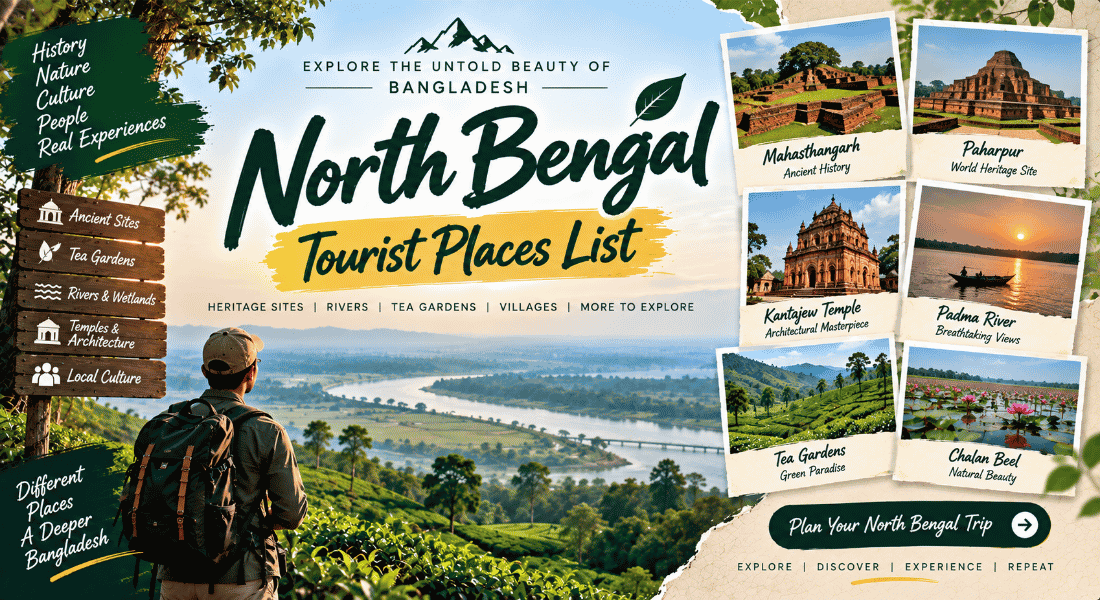
North Bengal is one of Bangladesh's most diverse and underrated regions. It's where you'll find the country's oldest archaeological sites, sprawling tea gardens, mighty rivers, and lush forests. From the ancient ruins of Mahasthangarh to the serene beauty of the Padma River, North Bengal offers a travel experience that's completely different from the rest of the country.
But with so many places to choose from, where do you start? This guide covers the essential North Bengal tourist places – the destinations that deserve a spot on your itinerary.
Why Visit North Bengal?
North Bengal is different from other parts of Bangladesh. The landscape is varied – from the flat plains of the Padma River to the rolling hills of the north. The history is deep – this is where the earliest civilizations in Bangladesh developed. The culture is distinct – with influences from across the region.
What makes North Bengal special:
Ancient history – Mahasthangarh, Paharpur, and Kantajew Temple are among Bangladesh's most important archaeological sites
Natural beauty – The Padma River, tea gardens, and forests offer stunning scenery
Rural experiences – The villages are among the most authentic in Bangladesh
Local crafts – Silk, mangoes, and traditional crafts are famous throughout the region
Less crowded – Compared to other tourist areas, North Bengal is relatively undiscovered
For more on the region's diverse attractions, check our guide on North Bengal nature, rivers, and offbeat travel.
Top Heritage Sites in North Bengal
Mahasthangarh
Mahasthangarh is the oldest archaeological site in Bangladesh. It dates back to at least the 3rd century BCE and was the capital of the Pundra kingdom.
What you'll see:
The ancient citadel walls – still impressive after 2,000 years
The Govinda Bhita temple
The museum with artifacts from different periods
The surrounding archaeological remains
The beautiful landscape along the Karatoya River
Historical significance: Mahasthangarh is the earliest urban settlement discovered in Bangladesh. It was continuously inhabited for over 2,000 years.
Location: Bogra district, about 10 kilometers north of Bogra town
Time needed: 2–3 hours
Best time to visit: October–March for comfortable weather
Paharpur (Somapura Mahavihara)
Paharpur is home to the Somapura Mahavihara, one of the most important Buddhist monasteries in South Asia. It dates back to the 8th century and is a UNESCO World Heritage Site.
What you'll see:
The massive monastery complex
The central stupa, which was once one of the largest in the world
The monastic cells around the central courtyard
The terracotta plaques with intricate designs
The museum with artifacts from the site
Historical significance: Paharpur was a major center of Buddhist learning and culture. It was one of the largest monasteries in the ancient Buddhist world.
Location: Naogaon district, near Paharpur village
Time needed: 2–3 hours
Best time to visit: October–March
Kantajew Temple
The Kantajew Temple is one of the finest examples of terracotta architecture in Bangladesh. It was built in the 18th century by Maharaja Pran Nath of Dinajpur.
What you'll see:
The beautiful terracotta decorations covering the temple
The three-tiered structure
The carvings depicting scenes from Hindu epics
The serene setting
Architectural significance: The temple is famous for its terracotta work. Every surface is covered with detailed carvings that tell stories from mythology.
Location: Dinajpur district, near Kantanagar village
Time needed: 1–2 hours
Best time to visit: October–March
For more heritage sites, check our guide on Mahasthangarh, Paharpur, and Kantajew Temple.
Natural Attractions in North Bengal
The Padma River
The Padma River is one of Bangladesh's great rivers. It flows through Rajshahi and surrounding areas, creating a stunning landscape.
What you'll see:
The vast river stretching to the horizon
The sandy banks where people gather
The boat traffic on the river
Spectacular sunsets over the water
Why it matters: The Padma is the heart of North Bengal's landscape. It shapes the region's geography, culture, and economy.
Best time to visit: October–March for pleasant weather, especially for sunset views.
Puthia Rajbari Complex
Puthia is home to several beautiful Hindu temples, built by the zamindars of Puthia. The complex is one of the most important architectural sites in Bangladesh.
What you'll see:
The Govinda Temple – an impressive 19th-century structure
The Shiva Temple – with its distinctive architecture
The Krishna Temple – smaller but beautifully decorated
The Dol Mancha – a unique pavilion
The palace buildings
Architectural significance: The Puthia complex shows the wealth and architectural taste of Bengal's zamindars.
Location: Puthia, Rajshahi district
Time needed: 2–3 hours
Chalan Beel
Chalan Beel is one of the largest wetlands in Bangladesh. It's a vast area of rivers, canals, and water bodies that support a rich ecosystem.
What you'll see:
The extensive water bodies
Bird life – many species visit the wetland
The fishing communities
The rural villages around the beel
Why it matters: Chalan Beel is vital for the region's ecology and supports thousands of people.
Location: Between Rajshahi and Rangpur districts
Best time to visit: During the dry season (November–March) when the water is clear
Mohastangarh and Karatoya River
The Karatoya River flows past Mahasthangarh, adding to the site's beauty. The riverbank is a peaceful place to explore.
What you'll see:
The river views
The archaeological site from the river
The local river life
Time needed: 30 minutes–1 hour
Tea Gardens and Hill Country
Teesta River and Surroundings
The Teesta River is another major river in North Bengal. It flows through the northern part of the region, creating a beautiful landscape.
What you'll see:
The river with its distinctive blue-green water
The surrounding hills
The rural villages
Location: Northern Bangladesh, near the Indian border
Best time to visit: November–March for pleasant weather
Rangpur and Surroundings
Rangpur is one of North Bengal's major cities. It's a good base for exploring the region.
What you'll see:
The city's colonial-era buildings
The local markets
The surrounding rural landscape
Offbeat Destinations
Dinajpur
Dinajpur is a quiet town with several interesting sites. It's the gateway to Kantajew Temple and other attractions.
What you'll see:
The local markets
The colonial architecture
The nearby Kantajew Temple
Location: Dinajpur district
Bogra
Bogra is the gateway to Mahasthangarh. It's also a city with its own charm.
What you'll see:
The city's busy streets
The local markets
The nearby archaeological sites
Naogaon
Naogaon is the gateway to Paharpur. It's a small town that's perfect for a quiet stay.
What you'll see:
The local village life
The nearby archaeological sites
Must-Try Experiences
Village Life
North Bengal's villages are among the most authentic in Bangladesh. Visiting a village gives you a glimpse into rural life.
What you'll experience:
Traditional homes and courtyards
Local crafts and traditions
The hospitality of village people
Authentic rural food
Local Food
North Bengal has its own culinary traditions.
Must-try foods:
Mangoes – Rajshahi is famous for its mangoes
Silk – Rajshahi silk is a local specialty
Local fish – From the Padma and other rivers
Traditional sweets – Each area has its own specialties
Handicrafts
North Bengal is known for its crafts.
Silk – Rajshahi silk is famous
Pottery – Traditional pottery is still made
Weaving – Traditional textiles are produced
Planning Your North Bengal Trip
Getting There
By road: North Bengal is accessible by road from Dhaka. The journey to Bogra or Rajshahi takes 6–8 hours.
By train: Trains connect Dhaka to Rajshahi, Bogra, and other cities. Train journeys offer scenic views.
By air: Some cities, like Rajshahi, have airports with flights from Dhaka.
Transport in the Region
Bus: Buses connect major towns and cities.
Private car: The most convenient option for visiting multiple sites.
CNG/rickshaw: Useful for short distances and local exploration.
Suggested Itinerary
3-Day North Bengal Heritage Itinerary:
Day 1: Bogra – Mahasthangarh
Morning: Drive from Dhaka to Bogra (6–7 hours)
Afternoon: Visit Mahasthangarh (2–3 hours)
Overnight: Bogra
Day 2: Paharpur and Kantajew
Morning: Drive to Paharpur (2 hours)
Visit Somapura Mahavihara (2–3 hours)
Afternoon: Drive to Kantajew Temple (3 hours)
Visit the temple (1–2 hours)
Overnight: Dinajpur or nearby
Day 3: Return to Dhaka
Morning: Local exploration
Return to Dhaka
5-Day North Bengal Discovery Itinerary:
Day 1: Dhaka to Bogra
Drive to Bogra
Visit Mahasthangarh
Overnight: Bogra
Day 2: Bogra to Paharpur
Drive to Paharpur
Visit Somapura Mahavihara
Overnight: Naogaon
Day 3: Naogaon to Kantajew
Drive to Kantajew Temple
Visit the temple
Overnight: Dinajpur
Day 4: Dinajpur to Rajshahi
Drive to Rajshahi
Visit the Padma River
Overnight: Rajshahi
Day 5: Rajshahi to Dhaka
Visit Puthia Temple Complex
Return to Dhaka
For more detailed itinerary options, check our guide on North Bengal itinerary.
North Bengal Tourist Places Summary
Practical Travel Tips
Best Time to Visit
October–March: The best time for visiting North Bengal. The weather is cool and comfortable.
April–September: Hot and humid. The monsoon (June–September) makes travel difficult.
What to Pack
Comfortable walking shoes
Light cotton clothing
A light jacket for cooler evenings
Sun protection
Insect repellent
Camera
Cash (small towns may not have ATMs)
Where to Stay
Bogra: Several mid-range hotels are available. Good base for Mahasthangarh.
Rajshahi: Hotels in various categories. Good base for the Padma and Puthia.
Dinajpur: Basic but adequate accommodation. Gateway to Kantajew Temple.
Naogaon: Limited options. Best for Paharpur visitors.
Safety Tips
Carry a copy of your ID
Secure your valuables
Stay hydrated
Take local advice on travel conditions
Conclusion
North Bengal is one of Bangladesh's most rewarding travel destinations. The ancient cities of Mahasthangarh and Paharpur are among the most important archaeological sites in South Asia. The Kantajew Temple is a masterpiece of terracotta architecture. And the Padma River is one of the most beautiful in Bangladesh.
Don't miss:
Mahasthangarh – Bangladesh's oldest city
Paharpur – A UNESCO World Heritage Site
Kantajew Temple – Terracotta architecture at its finest
The Padma River – One of Bangladesh's great rivers
Puthia – A complex of beautiful temples
Local villages – For an authentic experience
Local food – Especially Rajshahi mangoes and traditional sweets
For more on the region's tourist attractions, check our guide on top 10 tourist places in North Bengal.
FAQ Questions
1. What are the must-visit places in North Bengal?
The must-visit places are Mahasthangarh, Paharpur (Somapura Mahavihara), Kantajew Temple, the Padma River, and the Puthia temple complex.
2. How many days do I need to explore North Bengal?
3–5 days is ideal for exploring the main heritage and natural sites. 3 days covers the essentials, 5 days allows for a more relaxed pace.
3. What is the best time to visit North Bengal?
October to March offers the most comfortable weather for exploring the region. The monsoon (June–September) can make travel difficult.
4. Is North Bengal safe for tourists?
Yes, the region is safe for tourists. Exercise normal caution and follow local advice on travel conditions.
5. How do I travel between North Bengal's tourist sites?
Private car with driver is the most convenient option. Buses also connect major towns, but private transport gives you more flexibility.
6. What should I pack for North Bengal?
Comfortable walking shoes, light cotton clothing, sun protection, insect repellent, and a camera. Pack a light jacket for cooler evenings.
7. Where can I stay in North Bengal?
Bogra and Rajshahi have the widest range of hotels. Dinajpur and Naogaon have more limited options. Book in advance during peak season.
SEO Deliverables
SEO Title: North Bengal Tourist Places List: Top Destinations You Must Visit
Meta Description: Discover North Bengal's top tourist places – from ancient heritage sites like Mahasthangarh and Paharpur to natural attractions like the Padma River.
URL Slug: north-bengal-tourist-places-list
Primary Keyword: North Bengal tourist places list
Search Intent: Discovery
Suggested Internal Links
CTA: Ready to explore the rich heritage and natural beauty of North Bengal? Explore Otithi's North Bengal tour options for a thoughtfully planned journey through this remarkable region.