Blog
04
Aug
Traditional Arts, Crafts & Folk Traditions of Bangladesh
Traditional Arts, Crafts & Folk Traditions of Bangladesh: A Journey Through Boishakh Masks, Pottery & Nakshi Kantha Heritage
Meta Description: Discover traditional arts and crafts in Bangladesh. Explore Boishakh masks, pottery traditions, Nakshi Kantha embroidery, and rural craft communities preserving heritage.
Introduction
Your hands touch a clay pot made by someone who learned pottery from their grandmother.
The pot is imperfect. The walls are uneven. The color is muted. But it was shaped without a wheel. Without measuring tools. Without electricity.
This is traditional Bangladeshi craft.
It is not displayed in museums. It is not sold in fancy galleries. It is made in villages by people who have made the same things the same way for centuries.
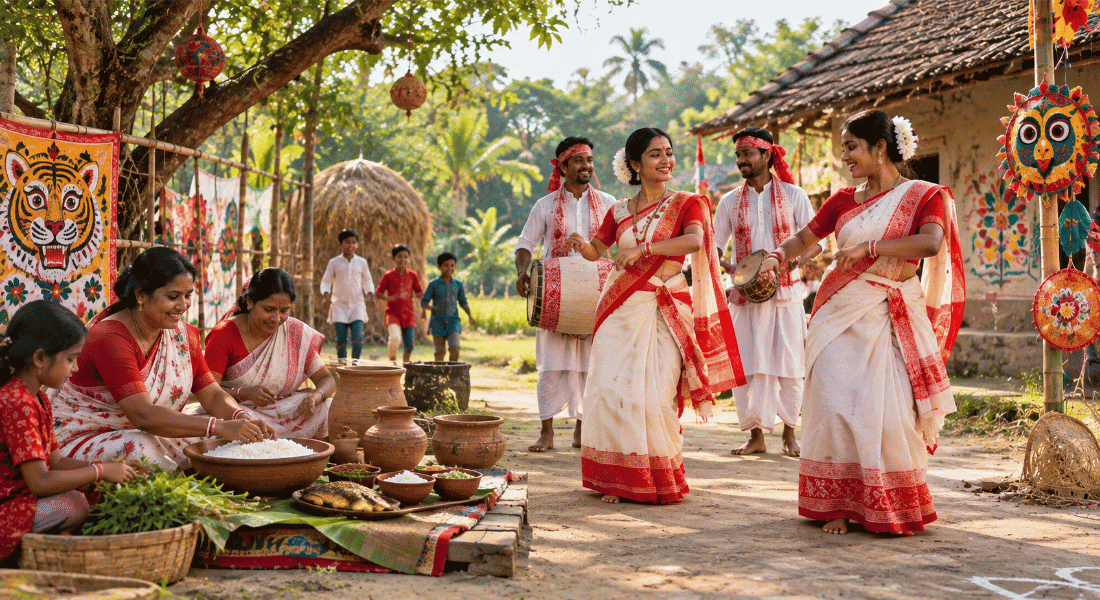
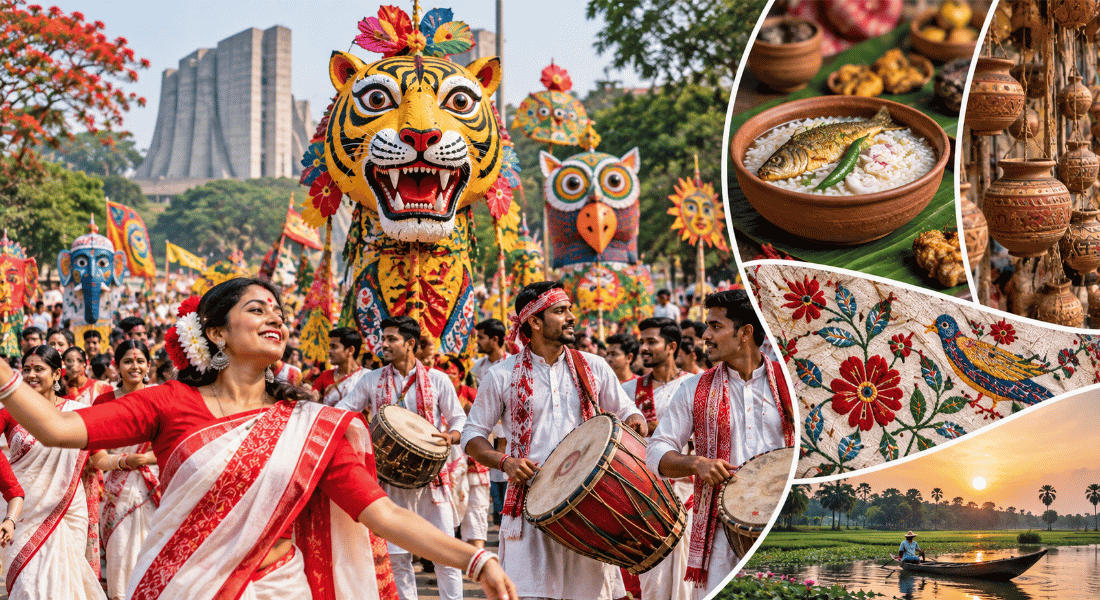
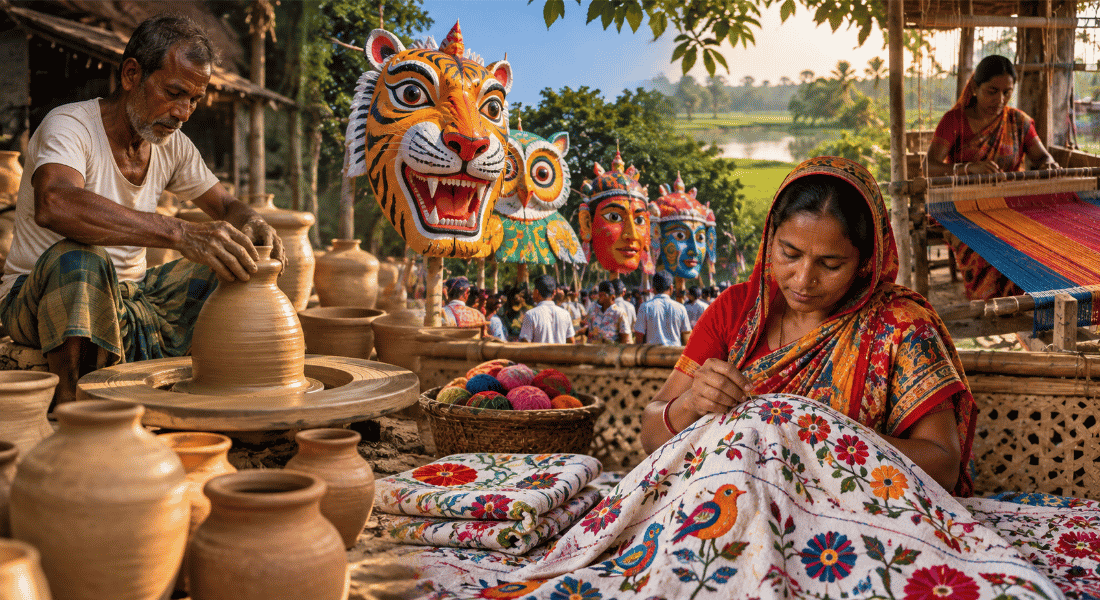
Bangladesh has a craft heritage most of the world never sees. Boishakh masks burst with color at Pahela Baishakh celebrations. Nakshi Kantha embroidery tells stories through stitches. Pottery comes from the earth and returns to it. Weavers create textiles using methods unchanged for generations.
These crafts do more than decorate. They preserve culture. They keep traditions alive. They give meaning to celebration. They connect families across time.
This guide takes you into rural Bangladesh. It shows you how artisans work. It explains why their crafts matter. It reveals how these traditions survive and change.
Boishakh Masks and Folk Art in Bangladesh
What Are Boishakh Masks?
Boishakh masks are large artistic creations made for Pahela Baishakh celebrations.
They are not small masks worn on the face. They are enormous. Some are taller than a person. Some are wider than a doorway. They are carried in processions. They are displayed in fairs. They represent the spirit of the festival.
The masks are made from papier-mâché, bamboo, clay, and other natural materials. Artists paint them in bold colors. Reds, yellows, greens, blues. The colors are bright. The designs are bold.
Each mask tells a story. Some masks show animals. Tigers, serpents, birds. Some show faces. Scary faces. Happy faces. Artistic faces. Some show abstract designs. Some show social messages. Some show mythological figures.
The masks originate from the 1989 Pahela Baishakh celebration at Dhaka University. Students created the first procession with masks. They wanted to celebrate Bengali culture. They wanted to create something that belonged to them, not to outside traditions.
That first procession had a few hundred people. It had simple masks. Now the Mangal Shobhajatra procession has hundreds of thousands of people. The masks are elaborate. Artists spend weeks creating them.
The Artistry Behind the Masks
Creating a Boishakh mask requires skill and creativity.
An artist starts with an idea. They sketch the design. They decide on size and shape.
Then they build the structure. Bamboo forms the frame. It is bent and tied. The artist knows exactly how to bend bamboo without breaking it.
Next comes papier-mâché. Paper mixed with paste. Layer after layer. Each layer strengthens the structure. An artist might use fifty layers of paper. The work takes days.
After the papier-mâché dries, the artist begins detailing. They carve features. They create texture. They add depth. Every detail serves the overall design.
Finally comes color. The artist paints carefully. Colors have meaning. Red for power. Yellow for happiness. Green for growth. Blue for mystery. The colors work together to express the mask's purpose.
The best mask artists are self-taught. They learn by watching their parents make masks. They practice for years. They develop instinct. Their hands know what to do.
A good mask takes two to three weeks to make. The artist might sell it for five to twenty dollars. The price seems low. But for a rural artist, this is significant income.
Masks and Cultural Significance
Boishakh masks represent more than art. They represent freedom.
During Pahela Baishakh, anyone can wear a mask. You can hide your identity. You can be someone else. You can express yourself without judgment.
In a culture with strong social rules, this freedom is important. The festival gives people permission to break normal rules. They dance. They sing. They shout. They celebrate wildly. The mask makes this acceptable.
Masks also preserve old traditions. Many mask designs come from ancient folklore. Tigers from hunting stories. Serpents from spiritual traditions. Birds from creation myths. When masks appear each year, these stories are remembered. Young people see them. They ask about them. The stories survive.
Political and social messages appear in masks too. An artist might create a mask about environmental destruction. About poverty. About women's rights. The festival becomes a space for social commentary. The art carries messages that people might not speak aloud.
Masks connect people across generations. A grandfather watches his grandson wear a mask. They remember their own mask-wearing days. They talk about how masks have changed. They talk about what masks mean. The tradition bridges age groups.
Pottery Traditions and Rural Artisan Life
The History of Bangladeshi Pottery
Potter communities in Bangladesh date back centuries.
Pottery was necessary. Before plastic, metal, and glass, everything was made from clay. Pots stored water. Pots cooked food. Pots served drinks. Pots preserved grain.
Potter families became specialists. They controlled the process. They understood clay. They knew how to shape it. They knew how to fire it. They passed this knowledge to their children.
Different regions developed different pottery styles. Red clay in some areas. Gray clay in others. Shapes varied by purpose. Tall pots for storage. Wide pots for cooking. Small pots for serving.
Potter communities in villages like Rayer Bazar near Dhaka became famous. People traveled to buy pots from specific potters. A potter's reputation mattered. Quality pots sold faster. Bad pots were forgotten.
Modern times threatened pottery traditions. Plastic containers became common. Cheap metal pots arrived. Pottery demand dropped. Potters' incomes fell. Young people left villages for cities.
But pottery still survives. Some families continue. Some potters adapted. Some create decorative pots instead of functional ones. Some teach tourists. Tourism provides income. Traditions continue.
How Traditional Pottery Is Made
Traditional Bangladeshi pottery uses methods unchanged for generations.
It starts with clay. A potter gets clay from the earth. In some villages, they dig clay from riverbeds. They collect it. They transport it home.
The clay is prepared. Potters mix it with water. They work out lumps. They remove stones. They knead it like bread. The process takes hours. Their hands become expert. They feel the clay's readiness.
Shaping happens without a wheel. The potter uses their hands. They coil clay into long snakes. They stack the coils. They smooth them together. The pot grows upward. The artist's experience guides the shape.
There is no measurement. No blueprint. The potter knows from feel. The walls should be this thick. The opening should be this size. The bottom should be this wide. Their hands know.
Once shaped, the pot dries. This takes several days. The potter moves it to a shaded area. The sun would dry it too fast. Fast drying cracks the pot.
Firing comes next. The potter stacks pots in a kiln. The kiln is heated. Hot fire hardens the clay. Temperature matters. Too hot and pots break. Too cold and they stay soft.
The whole process takes weeks. One potter might make five to ten pots per week. Each pot is slightly different. Each reflects the artist's hand.
The Economics of Pottery
A potter earns money from selling pots.
The price depends on size and quality. A small water pot might cost one dollar. A larger cooking pot might cost three dollars. Decorative pots might cost more.
Income is irregular. Pots that crack during firing are lost. Weather affects drying time. Demand varies by season.
Yet pottery provides essential income in villages. Many potter families make more from pottery than from farming. The work is continuous. Pots can be made year-round.
Young people see pottery as difficult work. They do not want to spend days making pots for low pay. They move to cities. They seek factory jobs. They seek office work.
But tourism changes this. When tourists arrive wanting to learn pottery, potters earn more. A tourist lesson might pay five dollars. The tourist buys pots at higher prices. The potter suddenly earns more. The work feels more valuable.
Families that welcome tourists continue pottery. Younger members become interested. They learn the craft. They teach tourists. They earn money. The tradition continues.
Nakshi Kantha Heritage and Embroidery Culture
What Is Nakshi Kantha?
Nakshi Kantha is a form of embroidery unique to Bengal.
The word Nakshi means "decorated" and Kantha means "quilt." So Nakshi Kantha is a decorated quilt.
Women create these quilts by hand. They use needle and thread. They stitch patterns onto cloth. The stitching covers the entire surface. The patterns are intricate. The colors are bold.
Each Nakshi Kantha tells a story. The stories come from daily life. A woman might stitch scenes of her village. A bazaar scene. A fishing scene. A wedding scene. A farming scene. The quilt becomes a visual narrative.
The best Nakshi Kantha quilts are family treasures. They pass from mother to daughter. They are used for special occasions. They are wrapped around newborns. They are placed on beds during important celebrations.
The tradition is ancient. Women in Bengal have embroidered quilts for centuries. The practice continues today. Women still create them. Families still use them.
Nakshi Kantha represents something important. It is women's art. Women create it. Women control it. Women decide what stories to tell. In a patriarchal society, Nakshi Kantha is a space for women's voices.
Creating a Nakshi Kantha Quilt
Making a Nakshi Kantha quilt takes months.
It begins with cloth. The woman chooses fabric. Usually white or light colored. She might gather old cloth. She might use new cloth. The cloth is prepared.
The woman plans her design. She might sketch it. She might work from memory. She might copy designs from other quilts. The design is her choice.
Then she stitches. She uses needle and thread. The thread is usually colorful. Reds, yellows, blues, greens. She stitches continuously. Hour after hour. Day after day.
The stitches are small. Each stitch is deliberate. The pattern emerges slowly. First outlines form. Then details fill in. Colors blend together. A scene comes alive on cloth.
The woman might work with other women. They sit together. They stitch and talk. They share the work. They teach younger women. They pass knowledge to the next generation.
A single Nakshi Kantha might take three to six months to complete. The woman stitches whenever she has time. After cooking. After cleaning. In the evening. On quiet afternoons.
The finished quilt is beautiful. It is unique. No two Nakshi Kanthas are identical. Each reflects the artist's style and vision.
The Stories Within the Stitches
Nakshi Kantha stories reveal daily life and values.
Some quilts show markets. Vendors selling vegetables. People buying. Animals. Movement. The quilt captures the energy of a bazaar.
Some quilts show farming. Fields of rice. Water buffaloes. Workers. Seasons changing. The quilt shows the farmer's year.
Some quilts show families. Houses. Children playing. Women cooking. Men working. Celebrations. The quilt shows how people live together.
Some quilts show spirituality. Religious symbols. Sacred animals. Spiritual scenes. The quilt expresses faith.
Some quilts show celebrations. Weddings. Births. Festivals. Gatherings. The quilt celebrates important moments.
Through these quilts, we see how Bengali women viewed their world. What they valued. What brought them joy. What concerned them.
Young girls learned these stories by watching quilts. They listened to mothers and grandmothers explain the designs. They absorbed values and traditions. The quilt was a teaching tool.
Now Nakshi Kantha is becoming rare. Fewer young women learn the craft. Modern quilts are manufactured. The handmade tradition is fading.
But some women continue. Some families commission quilts. Some tourists want to learn. Some cultural organizations teach the tradition. Nakshi Kantha survives, but barely.
Rural Craft Communities in Bangladesh
How Craft Communities Survive
Rural craft communities are villages or neighborhoods where people practice a specific craft.
Potter villages. Weaver communities. Mask-maker groups. Embroidery centers. Each community specializes in one or two crafts.
These communities exist because families concentrated in one place. A potter settled in a village. Other potters came. They shared knowledge. They competed. They formed a community.
The community system worked well for centuries. Apprentices learned from masters. Standards were maintained. Quality was consistent. Knowledge stayed within the community.
Today, community survival depends on several factors.
Young people must stay. If everyone leaves for cities, knowledge dies. Communities must offer income. Tourism helps. Selling to outside buyers helps. Government support helps.
Raw materials must be available. Potters need clay. Weavers need thread. Embroiderers need cloth. Communities near clay deposits or textile sources survive better.
External support helps. Cultural organizations promote crafts. Museums buy pieces. Tourists visit. Governments sometimes provide subsidies or support.
The strongest communities balance tradition with change. They teach old methods. They also experiment with new designs. They preserve heritage. They also adapt to modern markets.
Challenges Facing Craft Communities
Modern life threatens traditional crafts.
Factory-made products are cheaper. A plastic water pot costs less than a clay pot. A machine-made quilt costs less than a hand-made Nakshi Kantha. Consumers choose price.
Young people prefer other work. Factory jobs seem more prestigious. Office work seems more modern. Craft work is seen as backward. Parents discourage children from learning crafts.
Raw materials become scarce. Rivers change course. Forests shrink. Clay deposits are mined for construction. Natural materials become harder to find.
Markets change. People do not need handmade pots. They do not commission quilts. They do not buy masks outside the festival season. Demand shrinks.
The work is physically demanding. Pottery requires strong hands and back. Embroidery requires good eyesight and patience. As people age, continuing becomes difficult.
Income is low. Even full-time craft work provides modest income. A family cannot live comfortably on craft income alone.
Tourism as a Lifeline
Community-based tourism is changing craft communities.
Tourists want to see how things are made. They want to learn skills. They want to buy directly from artisans. They pay more than store customers.
A tourist lesson costs five to ten dollars. The artisan earns this in an hour. Regular sales might earn this in a day.
Tourists also ask questions. They show interest. This validation matters. When someone travels to your village to learn your craft, it signals that your work has value.
Tourism brings other income. Families host visitors. They provide meals. They offer accommodations. A single visiting family might bring fifteen to thirty dollars in total income.
Tourism also attracts attention. Local governments develop roads to craft communities. Media covers craft traditions. Cultural organizations provide support. The community becomes visible.
Young people see opportunities. If tourism grows, they can guide visitors. They can teach. They can sell to tourists. These are jobs available locally. Some young people stay.
Tourism is not a perfect solution. It can damage traditions if overdone. It can create dependency if poorly managed. But for many craft communities, it provides necessary support.
Cultural Tourism and Community-Based Experiences in Bangladesh
Experiencing Crafts Through Tourism
You can learn traditional crafts directly from artisans.
This is different from taking a class in a city. You go to the artisan's village. You work in their space. You use their materials. You learn their methods.
With a potter, you sit at their workspace. You watch them shape clay. You ask questions. You try shaping clay yourself. Your first attempt fails. They show you again. You try again. Your hands begin to understand.
With an embroiderer, you hold a needle. You make the first stitch. It is clumsy. She shows you how. You make the next stitch. Slowly, your hands learn the rhythm.
With a mask-maker, you help prepare materials. You learn how bamboo is bent. You apply papier-mâché. You paint. You see the mask emerge from your own effort.
This learning is slower than formal classes. But it is deeper. You understand not just technique but philosophy. Why this stitch? Why this shape? Why this color? The artisan explains.
You also see daily life. You eat meals with the family. You see how craft work fits into their day. You understand that craft is not separate from life. It is woven into life.
Economic Impact on Artisans
Craft tourism changes artisan income directly.
A weaver who normally sells to middlemen might get fifty cents per piece. That same weaver teaching a tourist earns five dollars per lesson. The tourist buys pieces at two to three dollars each. The income multiplies.
When income increases, families reinvest. They fix homes. They buy better materials. They buy better tools. They send children to school. Life improves.
Increased income creates stability. Instead of seasonal work with gaps, tourism provides work year-round. Families can plan. They can make long-term investments.
Income also attracts younger people. If pottery pays well, a young person might stay. If they see their parent earning good money from craft teaching, they might learn the craft. The tradition passes to the next generation.
Community income also grows. A family hosting tourists buys food from local farmers. They hire local workers. They rent from local landlords. Money circulates in the village.
How to Engage Responsibly
When you learn a craft, follow basic practices.
Pay what was agreed. The artisan set a price. Pay it fully. If you can pay more, offer it. Respect the price they set.
Respect their time. Craft work requires concentration. Do not interrupt constantly. Do not ask them to work while teaching. Let them work while you watch.
Ask before taking photos. Many artisans want photos taken. Some do not. Ask first. Respect their answer. Do not post photos online without permission.
Buy their work fairly. The price should reflect their labor. Do not haggle aggressively. The work took time. Compensate accordingly.
Learn by doing, not by watching from a distance. Get your hands dirty. Try the technique. Fail. Try again. This is how respect forms.
Share what you learn. Tell others about their craft. Post photos if permitted. Write reviews. Spread word about what you experienced. Artisans benefit from publicity.
Return if possible. Building long-term relationships is valuable. A repeat visitor is a friend. They provide consistent income. They provide continuity.
Frequently Asked Questions
What are traditional arts and crafts in Bangladesh?
Traditional arts and crafts in Bangladesh are handmade items created using methods passed down through generations. Examples include Boishakh masks made from papier-mâché, clay pottery shaped by hand, Nakshi Kantha embroidered quilts, and woven textiles. These crafts serve cultural purposes and are created by rural artisan communities throughout Bangladesh.
Why is Nakshi Kantha important in Bengali culture?
Nakshi Kantha is important because it is women's storytelling through stitches. Women create these embroidered quilts to record daily life, celebrations, and spiritual beliefs. The quilts pass through families as treasures. They teach younger women about culture and values. Nakshi Kantha represents a space where women's voices and creativity are visible and valued.
How do rural artisan communities preserve folk traditions?
Rural artisan communities preserve traditions by teaching younger generations their craft. Families pass skills from parent to child. The community reinforces standards and techniques. Tourism now helps by creating economic value for traditional crafts. When crafts are valued and compensated, families invest in teaching and learning. Communities also receive support from cultural organizations and governments focused on heritage preservation.
What is Boishakh mask art used for?
Boishakh masks are used during Pahela Baishakh celebrations, particularly in the Mangal Shobhajatra procession. The masks represent animals, faces, and abstract designs. They allow people wearing them to express themselves freely. The masks also serve to preserve folklore and cultural stories. Artists use masks to comment on social and political issues.
How can tourists experience Bangladeshi crafts?
Tourists can experience Bangladeshi crafts by visiting rural artisan communities through platforms like Otithi. You can stay with craft families, learn directly from artisans, purchase handmade products, and participate in the creative process. You can learn pottery, embroidery, mask-making, and weaving. This direct engagement supports artisans economically while giving you authentic cultural understanding.
Discover Authentic Craft Experiences with Otithi
Rural craft communities across Bangladesh welcome visitors.
Through Otithi, you can connect with artisans directly.
You stay in their villages. You learn their crafts. You participate in their traditions. You buy directly from them.
This benefits you. You gain skills. You gain understanding. You gain memories.
This benefits artisans. You provide income. You validate their work. You show that their traditions matter.
Otithi specializes in community-based tourism experiences. They connect you with families practicing traditional crafts. They arrange homestays. They facilitate learning. They ensure fair compensation.
Visit https://otithi.brac.net to learn more.
Explore craft-focused experiences at https://otithi.brac.net/packages
Understand Otithi's community tourism model at https://otithi.brac.net/about
Take Action
You now understand Bangladeshi craft traditions.
You know the skill required. The history behind it. The people who practice it. The challenges they face.
Traditional arts and crafts are not museum pieces. They are living practices. Real people create them. Real families depend on them.
When you engage with these crafts, you support their survival. You show that heritage has value. You give artisans reason to continue. You show young people that traditions matter.
Plan a craft-learning experience. Spend time with an artisan. Learn their technique. Buy their work. Share your experience.
This is not tourism. This is cultural exchange. This is support for living traditions.
Start your journey with Otithi. Discover authentic craft experiences across rural Bangladesh. Connect with artisans. Learn traditions. Support communities.
Your visit means more than you realize.